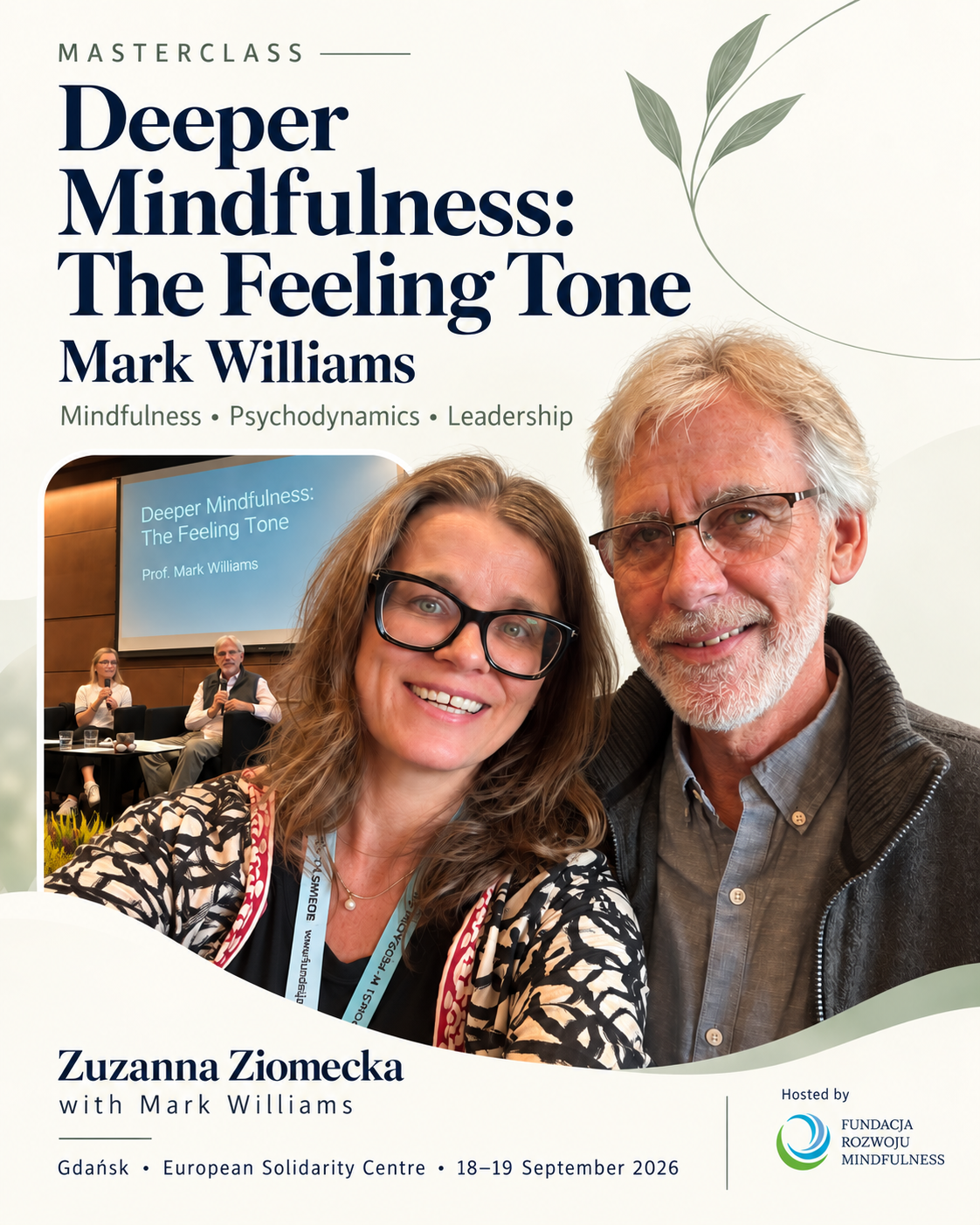
Last week, during Mark Williams’ two-day Deeper Mindfulness: Feeling Tone masterclass in Gdańsk, I had a brief conversation with him about something I have been thinking about : the bridge between mindfulness and systems psychodynamics.
We spoke about meaningful contact with mind and body and the capacity to observe one’s own experience from a meta-level when working psychodynamically with teams and organisations.
In systems psychodynamics, the consultant’s own experience is part of the data. Anxiety, pressure, irritation, urgency, confusion or withdrawal may not simply be “personal reactions”; they may also contain information about what is happening in the wider system. That makes the quality of the consultant’s attention crucial.
A practitioner who can notice what is arising internally, tolerate it without immediately acting on it, and create enough psychological space to reflect on it may be better able to distinguish between what belongs to them and what may have been picked up from the system. Mindfulness does not perform the interpretation for us. But it may strengthen our capacity to stay present long enough for interpretation to become possible.
During the masterclass, Mark drew our attention to an even earlier layer of experience: feeling tone.
In the Buddhist framework this is vedanā: the pleasant, unpleasant or neutral quality that arises in experience before the more elaborate stories, emotions and behavioural responses that often follow. Contemporary mindfulness research has increasingly explored feeling tone as an important point in the chain between contact and reaction. (ScienceDirect)
Mark’s teaching invited us to become more sensitive to that first movement: the almost immediate tendency to move towards what feels pleasant, away from what feels unpleasant, or to disengage from what feels neutral.
This matters enormously in leadership.
Before a leader becomes defensive, controlling, avoidant or reactive, something has often already happened at this more basic level. The situation has been registered as threatening, attractive, irritating, unsafe, exciting, intolerable.
Learning to notice that early tonal shift creates a small but consequential interval between impact and action.
And that interval may be one of the places where leadership becomes more mindful.
Mark used the image of “flying in bad weather.” I keep returning to it.
Leaders today are operating in conditions of sustained uncertainty: rapid technological change, geopolitical instability, economic disruption and worsening climate risk. Even within the AI industry, major figures are publicly disagreeing about how quickly development should proceed and how serious the associated risks may be. (Reuters) Climate disruption and geopolitical conflict are simultaneously affecting infrastructure, trade, energy and organisational planning. (Reuters)
Under those conditions, the temptation is often to narrow attention, defend familiar positions, seek certainty, or retreat into forms of self-containment that reduce anxiety in the short term.
But perhaps the deeper task is not to eliminate anxiety.
Perhaps it is to develop enough capacity to remain in contact with reality while anxiety is present.
This is where I see a meaningful convergence between mindfulness, systems psychodynamics and leadership development.
All three, in different ways, ask us to strengthen our ability to notice what is happening before we rush to discharge it.
To stay with experience long enough to think.
To distinguish signal from reaction.
To remain available to the system instead of becoming captured by it.
And, when the weather gets bad, to keep flying.